AutoTrust AI Releases Self Hosted JEV 27B Model
AutoTrust AI JEV-27B is an open-weights model for self-hosted AI agent decisions, trained on one NVIDIA B200 in about 9.2 hours.
AutoTrust AI has released JEV-27B, an Apache-2.0 open-weights decision model for self-hosted AI agents. The model adds a 108.9-million-parameter decision block to Alibaba’s open-weights Qwen3.8-27B backbone, while leaving the model’s generation and reasoning path unchanged. AutoTrust AI reports that the model trained in about 9.2 hours on one NVIDIA B200 and achieved an 84.07% average across six public text-decision benchmark groups. It is aimed at companies that want AI agents to make frequent structured decisions inside their own infrastructure rather than send each request to a third-party API.
Fast Decisions From One Model
JEV-27B handles yes-or-no questions, multiple-choice questions and 0 to 5 ratings in a single forward pass, returning a calibrated probability for each option. AutoTrust AI describes these fast, typed choices as System 1 decisions, while retaining System 2 generation and reasoning from the same set of weights.
The model’s decision block accounts for about 0.4% of its parameters. When that block is turned off, AutoTrust AI reports that all 164 HumanEval coding completions were byte-identical to the base Qwen3.8-27B model.
“Jev proved there is real demand for models that decide rather than write. JEV-27B shows that this capability can run on one GPU inside a customer's own infrastructure, next to a reasoning model. For companies that cannot send every decision to a third-party API, that changes both the cost and the risk.”
Benchmark Results And Limits
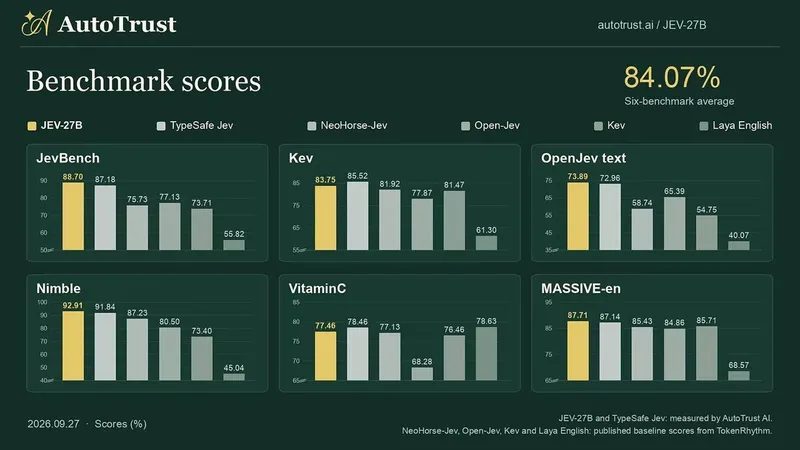
AutoTrust AI reported scores of 88.70% on JevBench, 83.75% on Kev, 73.89% on OpenJev text, 92.91% on Nimble, 77.46% on VitaminC and 87.71% on MASSIVE-en. Its 84.07% equal-weight average was slightly above the 83.85% average it measured for the hosted TypeSafe Jev 1.13 API on the same groups.
The company said these are internal comparative results rather than independent validation. For NeoHorse-Jev, Open-Jev, Kev and Laya English, it reproduced published figures from TokenRhythm rather than rerunning those models.
On 25,376 held-out questions labeled with Jev 1.13 probability distributions, AutoTrust AI reported a mean KL divergence of 0.017. On the independent decision-models-under-pressure benchmark, it said JEV-27B reached 96% of Jev 1.13’s accuracy across 16 answer options.
AutoTrust AI measured median local decision latency at 137 milliseconds and throughput at about 130 decisions per second on one B200. It noted that cited hosted API measurements are not directly comparable because they include network time and use different hardware, serving and concurrency conditions.
Agent Tasks In Demonstration
In its demonstration reel, JEV-27B acted as the decision engine for 10 tasks. The model played Doom, making 64 decisions in a target-practice scenario, steered a simulated drone through a MuJoCo obstacle course, ran a Google Flights search from Zurich to London and verified 21 results.
The release also describes the model navigating Wikipedia to Gödel’s incompleteness theorems, flagging four regression risks in a sample authorization-code change and routing a billing-refund ticket to support.
“Every AI agent is really a long chain of small decisions—which button to press, which file to open, which queue a ticket belongs in. Make each one fast, private and cheap, and you change the economics of the whole chain.”
Open Weights And Availability
JEV-27B is available under the Apache-2.0 license through its Hugging Face model page. The release includes model weights, the decision adapter, training and serving code, vLLM support and evaluation reports. A demonstration reel is also available.
The company said the model inherits Jev 1.13’s blind spots in multi-hop reasoning, arithmetic, dates and adversarial inputs, and that its training data is English-centric. It is not intended for high-stakes decisions, according to AutoTrust AI, which recommends confidence-based gating.
AutoTrust AI plans to add the JEV decision block to future models in its Guru family, which powers the ScienceGuru research platform for Windows and macOS. The company also offers customized sovereign deployments for enterprises.
From an announcement by AutoTrust AI.