Sofab Inks Raises $6 Million for Perovskite Solar
Sofab Inks raises $6 million to scale TinFab materials designed to improve reliability in perovskite solar cells and modules.
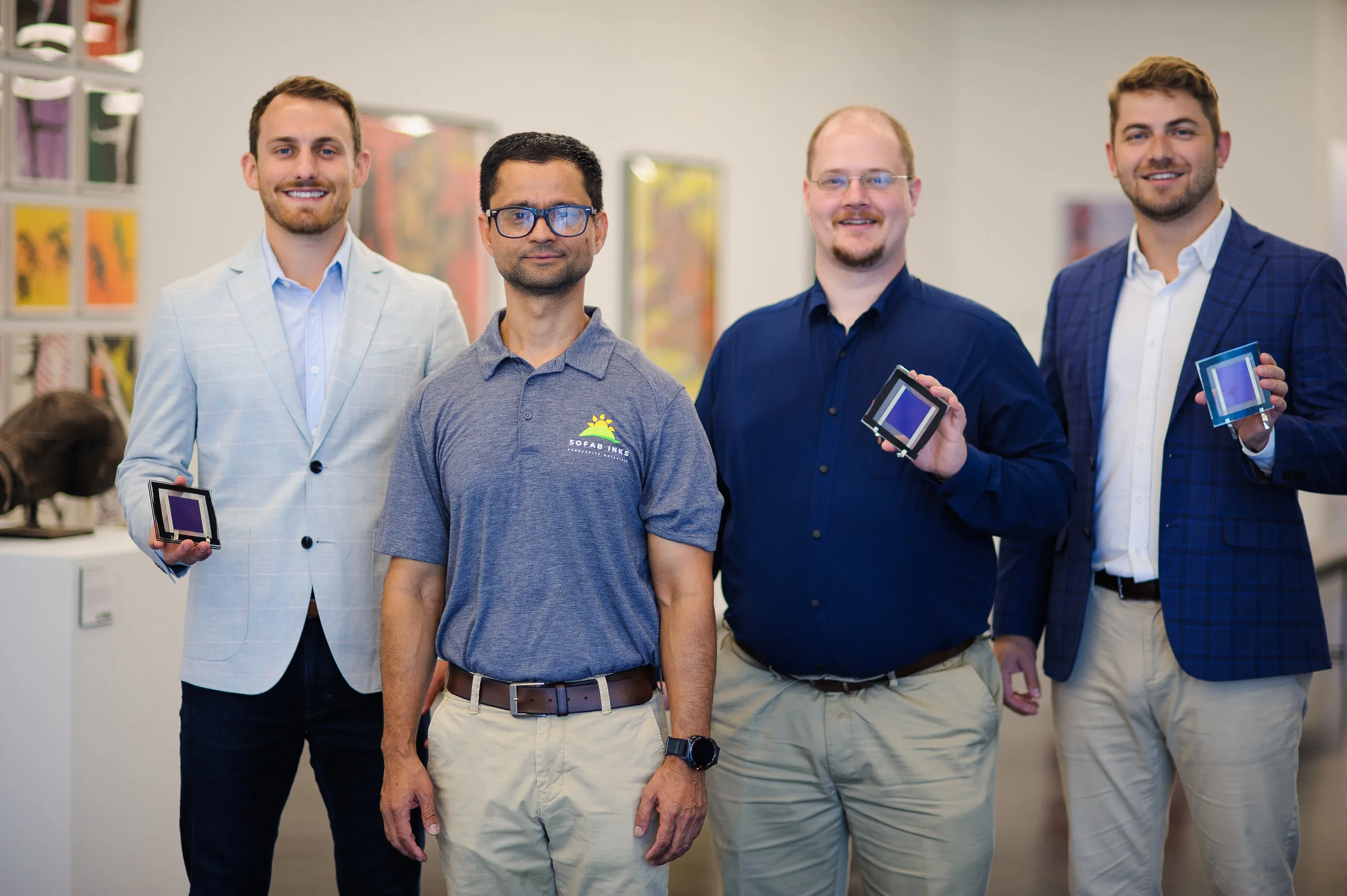
Sofab Inks has raised $6 million in seed funding led by Cloudberry Ventures to scale materials for perovskite solar cells. The Louisville company says its metal-oxide nanoparticle material replaces C60, a fullerene layer it identifies as a reliability weak point in perovskite devices. Sofab reports 22.3% efficiency on 30-centimeter single-junction modules and says it is commercially engaged or in late-stage discussions with about 90% of the perovskite industry. The funding will support high-velocity production and an engineering team expansion for 1-by-2-meter commercial specifications.
Aiming To Improve Reliability
Perovskite films are roughly 100 times thinner than silicon, according to Sofab, and can be made at lower temperatures. The company sees uses for the material in curved or weight-limited vehicle applications, lightweight satellite arrays, and small-format power for connected devices.
Sofab’s TinFab material is designed as an electron transport layer, replacing the fullerene layer used in perovskite cells. The company says its nanoparticles bond six to 10 times more strongly than C60.
“Perovskites are the first materials class that brings tandem solar into range for utility-scale deployment, the segment behind almost all of the roughly 2,800 gigawatts installed worldwide. A perovskite cell is only as good as its weakest layer, and the industry has been stuck with C60, a fullerene. It’s the largest source of voltage loss in the device and the point where fielded modules crack first. That’s the layer we replace. Our metal-oxide nanoparticles bond six to ten times more strongly than C60 and hold up at real sizes, running at 22.3% on 30-centimeter single junction modules. This funding moves us into high-velocity production as we triple our engineering team to manage the 1x to 100x scale-up for 1x2 meter commercial specs.”
Customer Development Work
The company names APS, ASU, Energy Materials Corporation, Halocell, and SunXT among the organizations it is working with or discussing commercial opportunities with. These relationships center on testing and scaling TinFab for perovskite photovoltaic manufacturing.
“Sofab has been an important nanoparticle ink partner during our development of high-performance Perovskite solar cells using high-speed, roll-to-roll equipment. We look forward to working with Sofab as we move toward commercialization.”
Scaling Perovskite Materials
Sofab Inks was spun out of the University of Louisville Conn Center for Renewable Energy with support from the US Department of Energy. Its focus is on electron transport layers and specialty inks intended for perovskite solar applications.
The seed round gives the company capital to expand engineering capacity and prepare its materials for larger commercial module formats. For solar manufacturers and developers working with perovskites, the company is positioning TinFab as a material intended to improve device durability while fitting high-speed production processes.
From an announcement by Sofab Inks.